Sunday, August 19, 2012

Shtetl Discovery

I have learned one of the first steps in seeking information about a Jewish ancestor from Eastern Europe is to determine the shtetl where they lived.  This was a new word for me.  So first, I needed to know what a shtetl is.  A shtetl was typically a small town with a large Jewish population in Central and Eastern Europe prior to World War II and the Holocaust.

In the 19th century shtetls were mainly found in the areas which were known as the Pale of Settlement in the Russian Empire, the Congress Kingdom of Poland, Galicia and Romania.  Since our family knows that Joseph stated Tauroggen as his birthplace in his naturalization papers, this placed his family in this area.

Further searching uncovered a description of life in the shtetl as noted in Chapter 15 of There Once was a World: a Nine-Hundred-Year Chronicle of the Shtetl of Eishyshok by Yaffa Eliach.  Although I can't be sure if the descriptions paralleled Joseph's life, there were certain aspects that may have impacted both his childhood and the remainder of his life.  Specifically:
  • The Household:  Often three generations lived under the same roof.  The pattern in Eastern Europe dating from at least the seventeenth century, was for young couples to establish their first household in the home of the wife's family. This made me wonder about the mention of Tilsit in connection with Joseph.  At one point it was thought that was his birthplace but this was corrected by finding his naturalization certificate and his US Army enlistment.  Now I wonder if perhaps that could be where his father was from and he came to Tauroggen where his wife's (Joseph's mother) family lived.  If you have any information that would shed light on this, please feel free to share.
         In addition, Joseph's mother passed away when he was a baby and his father remarried.  This meant he may have been part of another household.
  • Sons-In-Law:  The treatment a son-in-law received in his new household may have differed greatly from what he experienced in his home prior to his marriage.  In the matriarchal society of homes, a son-in-law was often thought to be doing wrong much of the time unless he he was an aspiring scholar.
  • The Jewish Matriarch:  In Eastern Europe of the seventeenth, eighteen, and nineteenth centuries, the home and its modest commercial enterprises were the woman's domain.  This makes it important to discover more about Joseph's mother and stepmother.  Could one of them have been the owner of the hotel/inn mentioned in Marrom family stories? 
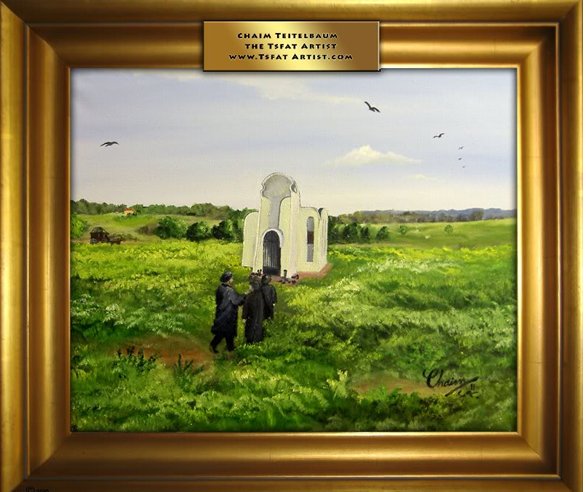
  • Painting of Anatevka:  Everything I knew, or thought I knew, of Jewish life in Russia prior to the Russian Revolution came from the movie,
    Fiddler on the Roof
  • Step-Siblings and Orphan Relatives:  During the eighteenth and nineteenth centuries and the first two decades of the twentieth, perhaps as many as two-thirds of the marriages in the shtetl were second, third, and even fourth marriages.  This was the result of death rather than divorce.  Death also created a large number of orphans.  Many spouses brought with them the children from previous marriages where they were often considered a heavy burden and resented.  Could this have contributed to Joseph's immigration to the United States at such a young age?  Another factor may have been the anti-Semitic practice in Russia of impressing Jewish teenage boys into mandatory military service for as long as a 25 years.
Really interesting information, but it seems to have raised more questions than it resolved.  I have identified Joseph's shtetl based on his identifying Tauroggen as his birthplace.
     Stetl:  Taurage (Alternative Names/Spellings - Taurage/Lithuanian,
              Tovrik/Yiddish, Tauroggen/German, Taurogi/Polish,
              Taurage/Latvian,
              Taurogen, Tarogen, Tauragunay, Tauragnu, Tauragnay,
              Tauraginos, Tauraginai
     District (Uyezd):  Zarasai (I also found a reference to Raseiniai)
     Province (Guberniya):  Kaunas

Random boy in Lithuanian shtetl posted on Webshots.com by  itzko102

Tuesday, March 13, 2012

Do You Know Moses Marrom?


In our quest to find relatives of "Grandpa" Joseph Marrom, we have repeatedly come across the name of Moses Marrom. Moses lived in Chicago and was born in Russia. He immigrated to the United States in 1881 or 1882. This could fit with the family tradition which has led us to believe that Joseph stayed with relatives in New York, Illinois and Wisconsin after immigrating from Russia.


So far I have not been able to locate Skaadwill, Russia which was the city Moses cited as his birthplace. The physical description for Moses on his passport application bears a resemblance to the physical stature of Joseph on his military enlistment papers. Both were relatively short men with dark hair and dark complexions.


At the turn of the century Moses had a saloon on Rush Street in Chicago. I have located what I believe are two wives for Moses: Sarah, who appears to have died (or left?) after 1894; and Betty who married Moses in 1899.


If Moses Marrom is a "leaf" on your family tree, it would be interesting to explore stories to see if this could be a link to finding more family members.

Monday, March 12, 2012

Joseph's Family Tree

Although it is just a stub, I have posted a family tree on Ancestry.com. Hopefully we will be able to add branches. Much research has already been done on the Selk line and I will be adding as I can. We are still trying to identify any siblings Joseph may have as well as searching for grandparents, aunts and uncles. The journey has been very slow and continues to show signs of being a "road less traveled." The hope is that other travelers may come across our path and open up new landmarks. Suggestions from other travelers are always welcome.

http://trees.ancestry.com/tree/38062873/family?fpid=19176871405

Sunday, September 25, 2011

Grace Marrom


Grace was born March 20, 1898 in Blackfoot, Idaho. From the little bit I was acquainted with Grace, I thought she was a lot of fun. However, when I met her, she had survived a rather nasty automobile crash which seriously injured one of her legs and resulted in ongoing pain for the remainder of her life.

Back to the stats: I found two marriages for Grace. The first marriage was to William M. Colman on December 26, 1926 in Dayton, Idaho. This marriage was either annulled or ended in divorce.

On July 9, 1929, Grace married Ernest M. Gibson in Caldwell, Idaho. I was fortunate to know Uncle Ernie as well. Grace and Ernie truly loved each other and looked after after each other through thick and thin. Ernie worked for a movie distribution company. While they were living in Sacramento, Grace would drive to Reno to visit her mother and play the slot machines. It was on one of these trips that Grad had the car accident.

When my husband and I were living at Lake Tahoe, Uncle Ernie and Aunt Grace came to visit us. Aunt Grace was in heaven at the Stateline casinos.

With no children of their own, Grace and Ernie spent much of their "family" time with her sister, Kay Kammerman and her family celebrating holidays and special occasions.

Grace died on August 1, 1970 in Slat Lake City, Utah. Practically inseparable, Ernie died just a few months later on January 14, 1971.

Sunday, September 18, 2011

Norma Marrom

Norma, the second child of Joseph and Annie, was born May 30, 1898 in Montpelier, Idaho. She attended Preston Central School for elementary education. She was among the first graduates of the Jefferson School following the school year 1914-1915.

She married James Henry Christensen who died in 1950 in Salt Lake City. Following his death Norma moved to Sacramento where she lived until her death in 1953.

Her obituary read:
"Mrs. Norma Marrom Christensen, 54, Sacramento, California, former Salt Lake resident, died Saturday at her residence of natural causes, according to word received by Salt Lake relatives.
Born May 30, 1899 in Montpelier, Idaho, she was a daughter of J.S. and Anna Selk Marrom.

She was married to Henry Christensen. He died in 1950. Mrs. Christensen then moved to Sacramento.

Surviving her are her mother, Mrs. Anna O'Keefe, Reno, Nevada, three brothers, W.L. and C.S. Marrom, both of Salt Lake City, Nate Marrom, serving with the U.S. Army; three sisters, Mrs. Grace Gibson, Sacramento; Mrs. Alice Keysor, Salt Lake City; and Mrs. Kay Kammerman, Pocatello, Idaho.

Funeral services will be conducted in Salt Lake City."

If you have additional information about Norma, please feel free to comment.

Saturday, September 17, 2011

Howard Marrom

Howard Marrom, the third child of Joseph and Annie, was born July 18, 1901 in Montpelier, Idaho. Montpelier, a small farming community in the Bear Lake Valley, is just none miles from Dingle where Lionel was born. This valley is located in southeastern Idaho near the Utah border.

Howard married Blanche Evans and was later divorced. They had one son, Paul Howard Marrom, who was born on November 19, 1935.

Howard died December 31, 1944 in Alameda County, California.

The attached slideshow shows Howard as a happy, confident young man.

Thursday, May 20, 2010

Yad Vashem


I recently had the opportunity to visit Yad Vashem in Jerusalem. It was a very emotional visit for me. As I walked through the various exhibits and memorials, I became astutely aware that if any of Joseph's family had not emigrated from the Lithuania area prior to 1939 they probably did not survive the war. Approximately 95% of the Jewish people living in the area were killed. I would like to share some of the experiences and history of the exhibits and memorials I visited.

The first exhibit we visited was the Children's Memorial. It was a haunting experience. As you walk through the memorial, a tape is playing stating the name, age and home city of each child known to have died in the Holocaust. It plays continuously while the museum is open. there are approximately 1.5 million names. The memorial was built with a grant from Abe and Edita Spiegel whose son, Uziel, died in one of the camps at the age of five. The stories of how children and infants were separated from their parents is chilling.

As you exit the Children's Memorial there is poignant statue of Janusz Korczak and some of his children, A doctor living in Poland, Janusz helpd found several orphanages. When the Nazis came to Warsaw and moved all of the Jews to the ghetto, Janusz and his orphans were forced to move as well. He worked tirelessly to provide for them, but eventually the children were ordered to the death camps. Janusz refused to leave them and they left for Treblinka together. Witnesses described Korczak and "his children" walking to the train holding hands, carrying knapsacks and marching witih dignity. All of them perished at Treblinka.

Along a pathway to other exhibits, we stopped on the Avenue of the Righteous Among Nations. This special "forest" consists of trees planted in memory of those who made tremendous efforts and sacrifice to save Jews during the Nazi regime. Many of them gave their lives in their effort to save others. We spotted a tree that had been planted in honor of Oscar Schindler.

The main exhibit winds through a large building along a serpentine path traveling through time beginning with the rise of Hitler and the Nazi party through the conquest of countries, the building of ghettos and the deportation of people to "the camps" and concluding with the liberation. Along the way are artifacts from the various cities, ghettos, camps and video testimonies of survivors. As I followed the winding path, I discovered an exhibit for the Kovno ghetto. Kovno is about 85 miles from Taurage.